GOVET honoured at the Ghana TVET Excellence Awards
On 14 April 2026, the TVET Excellence Awards were presented for the first time in Ghana, with support from the BMBFSFJ. Students and vocational schools received awards in nine categories, and international partners were also recognised.
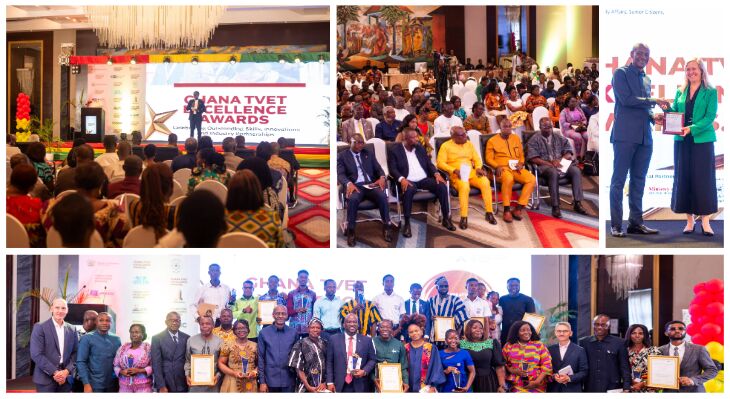
GOVET was honoured at this year’s Ghana TVET Excellence Awards for its support of vocational education and training reporting by Ghana’s Commission for Technical and Vocational Education and Training (CTVET). GOVET thus joins a group of international partners (including UNICEF and the BMZ) who have been recognised for their commitment to strengthening vocational education and training in Ghana.
The first Ghana TVET Excellence Award was funded by the Federal Ministry for Education, Family Affairs, Senior Citizens, Women and Youth (BMBFSFJ) and organised by the German Chamber of Commerce and Industry in Ghana (AHK) in collaboration with CTVET.
The recognition of GOVET demonstrates how important international partnerships are for the further development of vocational education and training systems. Together with partners such as CTVET, GOVET is working to strengthen transparent, data-driven and forward-looking structures in vocational education and training: in Ghana and beyond. The award underscores the importance of evidence-based governance in vocational education and training. In recent years, GOVET has supported CTVET in particular with the establishment and further development of reporting structures. The aim of this collaboration is to provide reliable data and analyses that improve policy-making processes in the TVET sector and promote sustainable development. The next vocational education and training report will be published in early May.
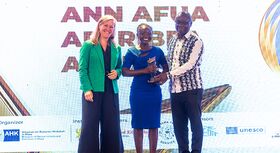
The Ghana TVET Excellence Awards recognised outstanding achievements and innovations in the field of technical and vocational education and training. The best vocational schools (pre-tertiary TVET) and technical universities were honoured. Particular highlights were the awards presented to female students who had completed their training in traditionally male-dominated professions. One such recipient was Ann Afua Appiah, a qualified welder who uses social media to try to inspire other young women to take up her profession. The runner-up, Obimpeh Betty Richest, also impressed the jury: as the only female student in a group of construction apprentices, she acts as a role model and continuously campaigns for more women in the sector.

In other categories, awards were presented to the most innovative students, the best students overall across all vocational schools, and the best teachers and practical trainers at the vocational schools.
The award for best vocational school went to the Fr. Dogli Memorial Technical Institute in the Oti Region, north-east of the Volta Reservoir, which impressed the jury with its impressive innovative projects, strong links to local industry and exceptionally good examination results among its students. The second- and third-placed vocational schools, the African Centre for Technical Training (ACTT) and Don Bosco, also demonstrated outstanding commitment.
GOVET was also involved in the jury’s selection of the winners. I was particularly impressed by the diverse commitment of the candidates and institutions to advancing vocational education and training in Ghana and to positively influencing career paths through their conviction.
Julia Olesen, GOVET project manager for bilateral cooperation with Ghana

Another significant highlight was the award for the best master craftspeople, i.e. the best trainers in the informal sector. The winner here was Priscilla Agordoh, who has been regularly mentoring trainees in her beauty salon for eight years and is actively committed to nurturing young talent.
TVET Excellence Awards are a well-established tool for bilateral cooperation and are presented by GOVET and the DLR Project Management Agency on behalf of the BMBFSFJ in various countries in cooperation with local partners.
The awards ceremony brought together stakeholders from politics, the field and international cooperation, and raised the profile of successful approaches within Ghana’s vocational training system.