GOVET supports the publication of the third Ghana TVET Report
The third Ghana TVET Report was officially launched at this year’s TVET Symposium organised by the Commission for Technical and Vocational Education and Training (CTVET) in Ghana. The report was produced by CTVET in collaboration with GOVET and was published under the patronage of the Ghanaian Minister of Education.
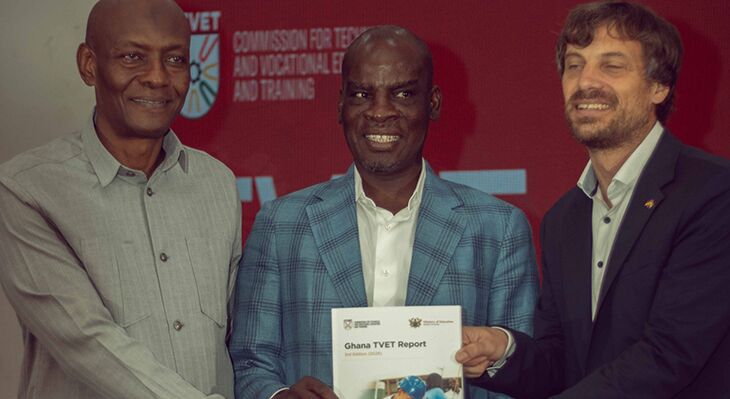
The report provides a comprehensive overview of the current state, challenges and development prospects of technical and vocational education and training (TVET) in Ghana and marks another important step towards data-driven and forward-looking TVET governance.
Ghana’s Minister of Education, Haruna Iddrisu, congratulated CTVET and GOVET on the publication of the TVET report during the TVET Symposium. The report highlights the central role of TVET in Ghana’s economic transformation. Given a young and rapidly growing population, as well as a rising demand for skilled workers in sectors such as construction, digitalisation, industry and services, vocational education and training is becoming increasingly important.
The report addresses key legislative processes and their implementation:
- the expansion of competency-based training (CBT), where 25,000 teachers have already been trained, and a total of 89 programmes have been developed to date
- the introduction and further development of the National TVET Qualifications Framework (NTVETQF)
- the strengthening of Workplace Experience Learning (WEL), with 82% of vocational schools stating that they ensure WEL for their students
- the promotion of Recognition of Prior Learning (RPL)
- as well as the greater involvement of companies and Sector Skills Bodies (SSBs), of which there are now 16, albeit with varying degrees of dynamism
The report also highlights significant progress in access to vocational education and training. The number of learners in public vocational education and training institutions has increased significantly since 2020. Enrolments in public TVET institutions rose from around 30,500 learners in 2019/2020 to nearly 70,000 in 2024/2025 – representing growth of approximately 137% over seven years. Reasons for this include the Free TVET Policy and targeted measures to make vocational education and training more attractive.
I would like to explicitly acknowledge the technical support provided by GOVET and BMBFSFJ to assist us with TVET data reporting. It encourages us to strive for better data management, quality assurance and strategic positioning of TVET data within the sector
Zakaria Sulemana, Director General of CTVET

For the first time, the report also included figures on certificates awarded: in total, over 139,000 learners have already been certified at National Certificate II level and more than 45,000 at diploma and HND level through various TVET programmes. It is now also clear how many students had actually registered for the examinations. This now reveals varying pass rates, ranging from less than 50% to over 90%.
The Ghana TVET Voucher Programme has also helped to strengthen training in the informal sector. The project, funded by KfW, reports that over 40,000 learners have already been certified.
For this report, CTVET analysed data from a total of 3,229 respondents across all 16 regions of Ghana – including learners, teachers, school heads and representatives of parents’ and teachers’ associations.
Focus on quality, digitalisation and inclusion
In addition to expanding access, the report devotes considerable attention to the topics of quality assurance, digitalisation, environmental and sustainability aspects, and inclusion. Challenges remain, particularly regarding infrastructure, equipment, funding and regional inequalities.
A particular focus is on the development of a modern TVET Management Information System (TVET MIS), which is intended to enable better data-driven management and evidence-based policy-making in the future.
Our consultancy work in the field of data reporting has seen rapid development in recent years: from basic indicators, the vocational education and training report has evolved into a comprehensive compendium, and the far-reaching considerations regarding a TVET MIS also demonstrate how firmly the topic of data has now become established.
Julia Olesen, Project Manager at GOVET
Furthermore, the report highlights the role of international cooperation in the further development of Ghana’s TVET system. Development and implementation partners support reform processes through technical advice, capacity building and institutional cooperation.
The cooperation between CTVET, BIBB and GOVET is a prime example of Germany’s international vocational education and training cooperation. The aim of the cooperation is to support Ghana in the further development of an inclusive, labour market-oriented and sustainable vocational education and training system. Since 2019, GOVET has supported the bilateral cooperation of the Federal Ministry of Education and Research (BMBFSFJ), and since 2022 there has also been institutional cooperation between CTVET and BIBB. The TVET symposium was organised in collaboration with UNICEF Ghana.