Germany and Uzbekistan sign Joint Declaration of Intent
16.06.2026
Germany and Uzbekistan intend to further expand their cooperation in vocational education and training (VET). With the signing of a Joint Declaration of Intent (JDoI) in Berlin on June 11, the Uzbek Ministry of Higher Education, Science and Innovation (MHESI) and the German Federal Ministry of Education, Family Affairs, Senior Citizens, Women and Youth (BMBFSFJ) have established a common framework for future collaboration.
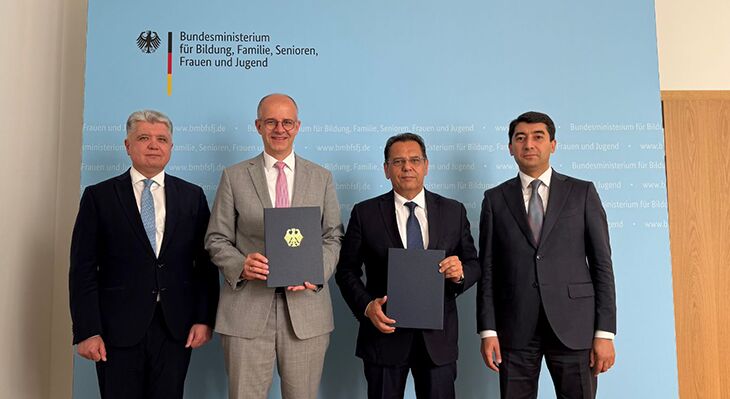
The agreement sends a strong signal about the importance of vocational training as a driver of economic development, employment, and social progress. Over the coming years, both countries aim to deepen their cooperation in key areas of action. Planned activities include exchanges on VET research, the further development of dual training approaches, the strengthening of governance structures, and the creation of new partnerships between vocational training institutions in Germany and Uzbekistan. A joint working group will support professional exchange and help initiate new cooperation projects.
Reforms with strong momentum

The signing comes at a time of profound change in Uzbekistan’s vocational education and training system. With a population of around 36 million, Uzbekistan is the most populous country in Central Asia. Each year, the population grows by approximately one million people, and around 700,000 young people enter the labour market.
Providing this young generation with relevant skills and qualifications is one of the country’s most important future challenges. Accordingly, the government has been pursuing reforms for several years to align vocational education more closely with labor market needs. The legal framework for dual training models was established as early as 2021, and their share is now expected to increase further. At the same time, issues such as digitalisation, green and sustainable economic development, and the qualification of vocational education personnel are at the center of ongoing reforms.
Building on existing cooperation
The new declaration of intent builds on many years of cooperation between German and Uzbek partners. An important component of this collaboration is the “TexVET” project, implemented by the German Agency for International Cooperation (GIZ), which supports the modernisation of vocational education and training in Uzbekistan.
At the closing conference of the project’s first phase in Samarkand in October 2025, representatives from government, vocational education practice, and international cooperation gathered to discuss achievements and explore future perspectives for the development of the system. The newly signed agreement provides a framework for building on these experiences and jointly developing new initiatives.
Vocational training as a bridge between Germany and Central Asia
The agreement also reflects the growing relationship between Germany and the countries of Central Asia. The region is gaining increasing economic and geopolitical importance. Germany supports reform and modernization processes in the region through cooperation in education, science, and research.
Vocational education and training plays a central role in this context. It creates opportunities for young people to acquire skills and qualifications, strengthens the skilled workforce, and supports economic transformation processes. Through the Joint Declaration of Intent, Germany and Uzbekistan have now established an institutional framework to further deepen this exchange. The agreement will initially remain in force for four years and is intended to serve as the foundation for joint projects, pilot initiatives, institutional partnerships, and an ongoing policy dialogue in the field of education.