What skills are needed for the green transition?
G.R.E.A.T. Conference at the University of Cologne
What skills are needed for the green transition, and how can they be taught through vocational education and training? International researchers and experts discussed these questions at the fifth G.R.E.A.T. Conference at the University of Cologne.
Green Skills – what skills are needed?
What skills do skilled workers need for a more sustainable world of work? And how can these ‘green skills’ be taught in vocational education and training? International researchers and experts addressed these and other questions from 21 to 23 September 2026 at the fifth international conference organised by the German Research Centre for Comparative Vocational Education and Training (G.R.E.A.T.) at the University of Cologne.
A study by Juan P. Gamboa and Mónica Moso-Díez, together with their research team, on the Spanish vocational education and training system demonstrates just how diverse the requirements can be. The researchers identified 312 essential green skills for 71 occupations linked to vocational education and training. They categorised these into ten areas of competence. This reveals a two-part structure: some of these skills, for example in waste management, are relevant to numerous vocational training programmes and value chains. Others are more closely tailored to individual sectors. From the researchers’ perspective, green skills should therefore not be viewed in isolation. Rather, vocational training programmes should combine cross-cutting ‘core green competencies’ with sector-specific specialisations.
The example of the construction sector in Cologne also illustrates that sustainable professional practice requires a range of different skills. Based on 53 interviews, Farina Koller and Hanna Link investigated which green skills skilled workers in the construction industry need. Technical expertise, planning skills and the practical implementation of sustainable construction methods were frequently cited. At the same time, communication and collaboration with other trades play an important role. Added to this are methodological skills, such as digital skills for planning processes, as well as personal skills, such as an awareness of the importance of sustainability in a professional context and a willingness to engage with the issue.
This makes it clear that so-called ‘green skills’ are not limited to working with ‘green’ technologies. The ability to act sustainably in a professional context can combine technical, social, methodological and personal skills.
From strategy to everyday training
A key challenge lies not only in defining skills for greater sustainability, but in actually embedding them in training and teaching. Annabell Albertz from the University of Cologne investigated how these skills are embedded in curricula and implemented in training practice, using Indian Industrial Training Institutes (ITIs) as a case study. To this end, five curricula from four different vocational trades, as well as the curriculum for the cross-disciplinary subject ‘Employability Skills’, were analysed. In addition, 54 teachers at 18 institutes in Delhi and Bangalore were interviewed. The study shows that, in the trade-specific curricula examined, green skills have so far been incorporated only marginally and in a rather unsystematic manner. Many of the teachers interviewed stated that green skills were not included in the curricula and were therefore not implemented in the classroom. Where they are addressed, this tends to be in relation to topics such as waste separation or the use of environmentally friendly resources. The findings therefore point not only to opportunities for integrating technical green skills more firmly into the curricula. Teachers also require targeted support to successfully integrate green skills into their teaching practice.
Similar challenges are evident in Cologne’s construction sector. According to the findings of Koller and Link, green skills have so far been integrated only to a limited extent into vocational training, curricula and examinations. In practice, their teaching depends in part on the personal commitment of individual teachers. Among other things, the experts surveyed cited a lack of teaching materials, a shortage of suitably qualified teachers and outdated school buildings as further obstacles. Collaboration and networks, on the other hand, can play a supportive role. In particular, the respondents highlighted the collaboration between vocational schools and trade guilds and associations.
Which green skills for which transformation?
Margarita Langthaler from the Austrian Research Foundation for International Development focused her presentation on the fact that even the question of which skills are required cannot be answered unequivocally. She analysed 69 strategy documents from nine international organisations and examined the understanding of green transformation underlying international debates on green skills.
Her analysis shows that the discourses examined predominantly lie between incremental and reform-oriented approaches and largely remain within the existing economic growth model. Fundamentally transformative perspectives, by contrast, are scarce. Langthaler thus links the discussion on green skills to a broader question: is it sufficient to supplement existing vocational education and training systems with additional ‘green’ skills, or must their fundamental objectives, assumptions and practices also be re-examined?
Sustainability along the supply chain: the VET Chain
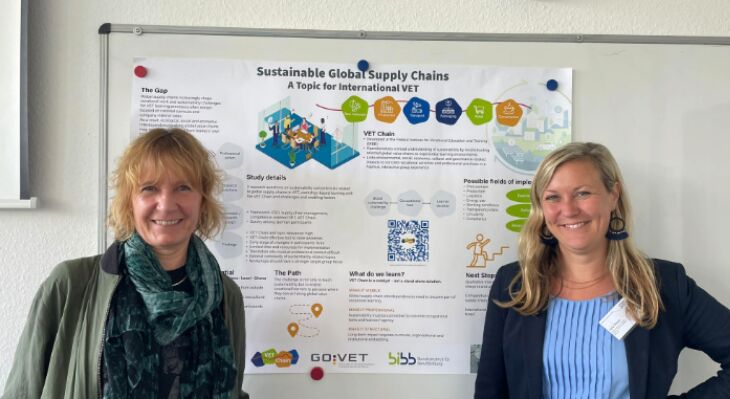
GOVET was also represented at the G.R.E.A.T. Conference with its own presentation. Hannelore Kress, Julia Olesen and Ralf Hermann introduced the VET Chain. This is an interactive learning format developed by GOVET at the BIBB, which links global supply and value chains with issues of sustainability and vocational education and training.
A shortened version of the normally more extensive workshop was used at the conference. Using chocolate as an example, participants traced the product’s journey from cocoa production through various stages of processing right up to sale. One part of the group examined the individual stages of the supply chain and discussed the challenges arising there in terms of sustainability and climate change, as well as where, for example, resources or energy could be saved. Another group focused on the people and occupations involved at the various stages of the value chain.
At the same time, GOVET presented the results of a survey of 40 former workshop participants from Germany. 94 per cent of participants rated the workshop’s contribution to understanding global sustainable supply chains as good or very good, and 78 per cent considered it likely or very likely that they would apply what they had learnt in their own context. However, this is often hampered by a lack of time and resources. Among the participating apprentices, it is striking that sustainability has so far played hardly any role outside the VET Chain workshop. Overall, the feedback shows that the VET Chain is suitable as an awareness-raising tool; however, a broad range of approaches is needed to embed sustainability in education and the workplace in the long term.
Sustainability as a challenge for vocational education and training
The papers presented at the G.R.E.A.T. Conference highlight different perspectives on skills relating to sustainability, ranging from the systematic identification of required skills, through their integration into curricula, to their practical delivery. The examples from the conference illustrate both cross-cutting and occupation- and sector-specific skills requirements.
Another common challenge lies in implementation. Studies from India and the Cologne construction sector indicate that green skills have so far been incorporated into curricula and training practice only to a limited extent or in an unsystematic manner. At the same time, the papers make it clear that, alongside the development of suitable learning formats, the long-term institutional embedding of green skills remains a key task for vocational education and training.
The G.R.E.A.T. at the University of Cologne
The German Research Center for Comparative Vocational Education and Training (G.R.E.A.T.) was founded in 2010 at the Institute of Vocational, Economics and Business Education (Chair, Professor Pilz) at the University of Cologne. It devotes itself to comparative research, development and implementation support and to the provision of guidance in international VET cooperation. The Federal Institute for Vocational Education and Training (BIBB) is represented on the Advisory Council by Birgit Thomann, Head of The “VET International” Department.