Online discussion: Youth Apprenticeship in the USA – Vocational training begins as early as secondary school
4th Transatlantic VET Dialogue
How can school-based learning be combined with paid work experience? How can young people be encouraged to take up an apprenticeship? What can Germany learn from the USA? These questions are the focus of the online discussion with GOVET, New America and the Wisconsin DWD.
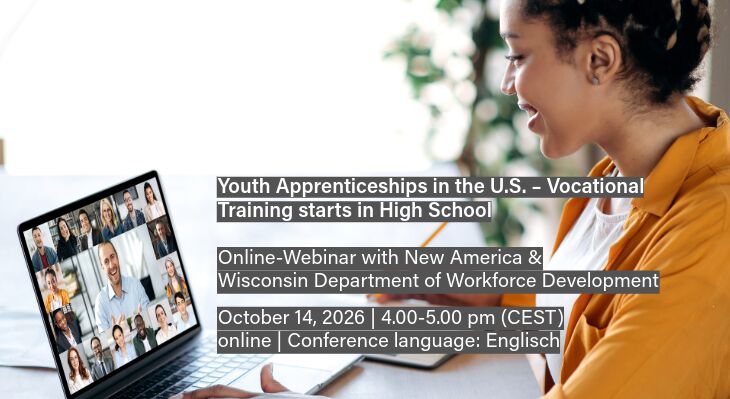
The event centres on looking beyond one’s own horizons: How can young people be encouraged to pursue vocational learning at an early stage? How do schools, companies and other stakeholders work together? And what insights can the Youth Apprenticeship programme offer for the discussion on successful transitions from school to vocational training in Germany? The online event will take place on 14 October 2026 from 4.00 pm to 5.15 pm (CEST) via WebEx.
Following a welcome address by Prof. Dr Hubert Ertl, Research Director at the Federal Institute for Vocational Education and Training (BIBB), experts from the USA will present the Youth Apprenticeship concept and its practical implementation in the state of Wisconsin.
The webinar will focus in particular on the following aspects:
- Cooperation between secondary schools, companies and vocational education
- Informing young people about participation and involving companies
- Coordination of the various learning environments and the establishment of regional networks
- Organisation of in-company learning phases and the recognition of learning outcomes
- Continuation of the Youth Apprenticeship programme after leaving secondary school
- Does early entry into vocational learning reduce transition losses and subsequent drop-outs?
- What can German vocational education and training learn from this model, and which previous approaches could be adapted to modern requirements?
The event is aimed at German professionals in the fields of vocational education and training, education and labour market policy, academia and practice, as well as chambers of commerce, social partners and others with an interest in international vocational education and training systems.
Training begins as early as secondary school
The Youth Apprenticeship Programme in Wisconsin is aimed at pupils in their final years of secondary school. The young people are employed and paid by participating companies. Workplace experience is combined with subject-specific teaching, whilst the young people continue to work towards their high school qualification.
This creates a close link between school, workplace learning and further vocational training pathways. After completing high school, the vocational development they have begun can be continued, for example through a Registered Apprenticeship.
What can we learn from the USA?
Of particular interest to German vocational education and training is how young people can be reached and encouraged to engage with vocational learning at an early stage. If pupils gain practical work experience, familiarise themselves with career profiles and take on responsibility whilst still at school, career guidance can become more meaningful and the transition to vocational training can be more successful.
This issue is also relevant in light of the high number of young adults in Germany without a vocational qualification. The webinar therefore explores how the Youth Apprenticeship scheme can help to stabilise transitions from school to vocational training, reduce drop-out rates and open up pathways to a recognised vocational qualification.
It is explicitly not a question of transposing the American model onto Germany. Rather, the focus is on mutual learning from different vocational education and training systems: Which elements work in Wisconsin? What institutional prerequisites are required? And which approaches might also be of interest to the German debate?
Not an American-style of the German ‘BerufsAbitur’
The Youth Apprenticeship programme does not correspond to the German ‘BerufsAbitur’. It does not centre on a dual qualification comprising a vocational qualification and university entrance eligibility. Rather, paid and structured work-based learning is integrated into the regular high school curriculum.
The young people remain pupils whilst working in a company. Employers, schools and regional coordination centres coordinate the training and employment framework with one another.