2025 Year in Review: VET Chain – Experiencing sustainability along the supply chain
16.12.2025
The 2025 Year in Review shows that the VET Chain has established itself as an effective tool for sustainable training. Over 100 participants used the interactive tool in workshops, training courses and continuing education programmes this year.
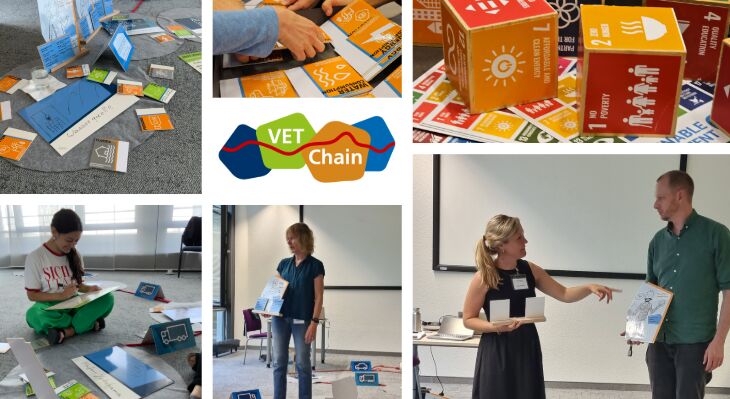
How can sustainability be more strongly integrated into everyday training – and what specific approaches are there for this? What can trainers do to promote sustainable thinking and action? What role does company management play, and how can trainees themselves take responsibility? And why is it crucial to consider the issue of sustainability along the entire supply chain?
These questions were the focus of work with the VET Chain in 2025. The interactive advisory tool was developed under the leadership of GOVET in the international department of the Federal Institute for Vocational Education and Training (BIBB).
Since its introduction in 2023, the VET Chain has established itself as an effective tool in vocational training. More than 250 participants have so far taken the opportunity to learn about and use the tool in workshops, training courses and further education programmes. It is particularly gratifying that more and more former participants are taking up the VET Chain on their own initiative, planning their own workshops and thus contributing to putting the idea of sustainable vocational training into practice.
Notice: This video is hosted on the Youtube channel of the BIBB. If you play this video here, data will be transferred to Youtube or Google. Please find further information in our data privacy statement.
VET Chain: The year 2025 in review
Vocational training in the context of sustainable supply chains
The importance of supply chains and qualified skilled personnel is steadily increasing in the context of socio-ecological transformation. Questions about fair and sustainable working and production conditions are coming more sharply into focus.
Against this backdrop, the interactive advisory tool VET Chain was developed two years ago in the international department of the Federal Institute for Vocational Education and Training (BIBB) under the leadership of GOVET. It illustrates vocational education and training along the supply and value chain and sensitises vocational education and training stakeholders to training scenarios and job profiles in a global context.
Participants take on the perspective of trainees along a supply chain and reflect on the challenges and opportunities of sustainable development. This work not only promotes understanding of sustainability-related vocational skills, but can also provide impetus for structural changes in production and work processes.
Events and milestones 2025
- 11 to 15 February 2025: didacta education fair in Stuttgart
- 26 February 2025: Open workshop at BIBB
- 13 and 14 March 2025: Training of trainers at BIBB
- 24 June 2025: Teachers' day at Carl Reuther Vocational College
- 26 June 2025: Open workshop at BIBB
- 3 and 4 July 2025: Training of Trainers at BIBB
- 28 October 2025: Internal training at BIBB
- 4 and 5 December: Training of Trainers at BIBB
With the growing number of trainers and the independently initiated workshops of former participants, a lively network is emerging that is carrying the VET Chain forward.
For 2026, there are plans to expand international cooperation within the framework of the VET Chain – in the first half of the year, a workshop will be held with partners from the bilateral cooperation with Costa Rica.
In addition, the tool is to be integrated even more closely into vocational education and training practice. The aim remains to systematically promote sustainable skills and strengthen vocational education and training as a driver of socio-ecological transformation.
In German vocational education and training, the topic of sustainability is firmly anchored in the so-called standard occupational profiles.
Since 1 August 2021, four modernised standard occupational profiles have been considered minimum requirements in all newly developed or modernised training regulations. The standard occupational profiles are cross-cutting topics that are taught in all occupations. They must be implemented in every recognised training occupation and can be supplemented with specific content depending on the industry. They apply to the areas of ‘organisation of the training company, vocational training, labour law and collective bargaining law’, ‘health and safety at work’, ‘environmental protection and sustainability’ and ‘digitalised working environment’.
Sustainability is therefore an integral part of every training programme. Trainees learn to act in a resource-efficient, energy-saving and responsible manner and acquire key skills for the labour market. For companies, integrating sustainability into training practices can help them achieve their own sustainability goals.